Why Understanding Your Baby’s First Motor Skills Matters
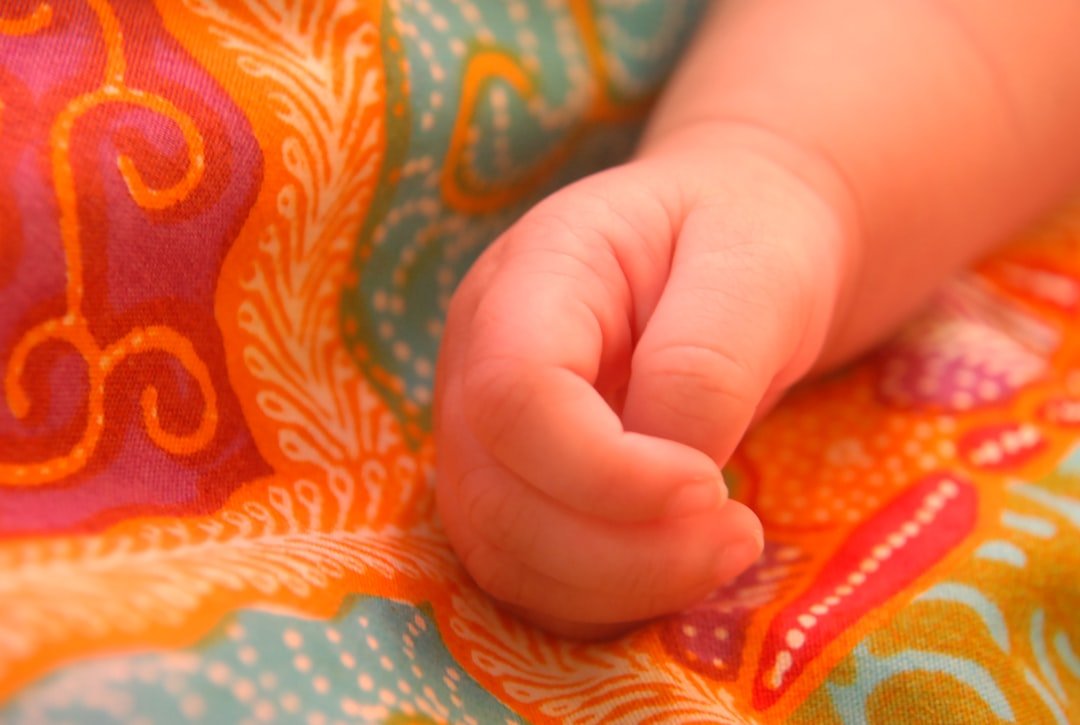
0 3 months fine motor skills are the tiny but crucial movements your baby makes with their hands and fingers during their first three months of life. These early movements—like bringing hands to mouth, opening and closing fists, and reaching for objects—lay the foundation for everything from self-feeding to writing later on.
The first three months of your baby’s life are a period of remarkable change. As one pediatric source notes, “By the time your baby is three months of age, she will have made a dramatic change from a totally dependent newborn to an active and responsive infant.” During this time, your baby loses many newborn reflexes and gains more voluntary control over their body.
Fine motor skills don’t develop in isolation. They build on a foundation of gross motor skills—the larger movements involving the arms, legs, and trunk. When your baby pushes up during tummy time, they’re not just strengthening their neck and shoulders; they’re creating the stability their hands and fingers need to work precisely. This principle, called “proximal stability leads to distal mobility,” means your baby needs a strong core and shoulders before their hands can master delicate movements.
Understanding these early milestones helps you know what’s typical, what activities support development, and when it might be time to talk with your pediatrician. Every baby develops at their own pace, but knowing the general timeline gives you confidence as a parent.
At KidStart Pediatric Therapy, we’ve supported hundreds of families in understanding and promoting healthy 0 3 months fine motor skills development. Our evidence-based, play-focused approach helps children who may be experiencing delays reach their developmental potential through coordinated, individualized care.
Understanding Your Baby’s First Movements
The journey of a baby’s development is fascinating, as simple, reflexive movements evolve into purposeful actions. During the first three months, both fine and gross motor skills unfold rapidly, each supporting the other.
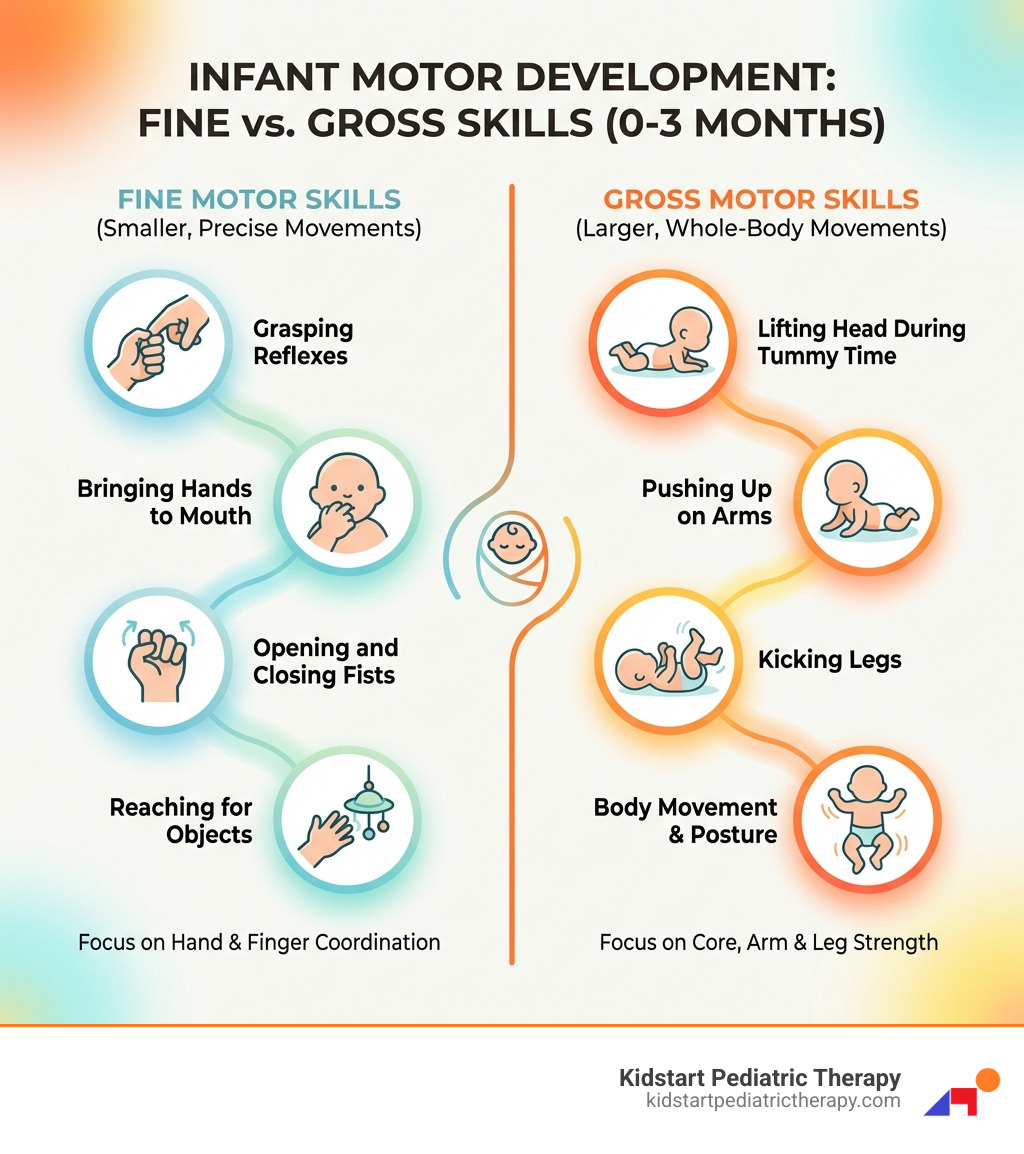
Fine motor skills involve the precise use of small muscles in the hands and fingers for tasks like grasping. Gross motor skills use large muscle groups in the arms, legs, and trunk for bigger movements like lifting their head or kicking. Development follows a predictable path from head to toe and from the core outwards. This means gross motor skills, which build core strength, generally precede fine motor skills. This concept, known as “proximal stability leads to distal mobility,” is fundamental: a baby needs a strong, stable core and shoulders before they can achieve refined movements with their hands. For more insights into these foundational movements, explore our guide on motor skills.
Fine Motor vs. Gross Motor Skills in Infants
To understand 0 3 months fine motor skills, it’s helpful to differentiate them from gross motor skills.
Gross motor skills in infants (0-3 months) involve large muscle groups. Examples include:
- Lifting their head during tummy time.
- Pushing up on their arms.
- Kicking their legs vigorously.
- Turning their head from side to side.
These movements build the strength and postural control necessary for all later development.
Fine motor skills in the 0-3 month range focus on smaller muscles, often coordinated with eye movements. Examples include:
- Tight grasping (reflexive at first).
- Bringing hands to the mouth.
- Opening and shutting hands.
- Swiping at objects.
- Briefly holding small objects.
The interplay is constant. As gross motor skills improve head control, a baby can better track objects visually, which in turn supports the fine motor skill of reaching.
The Role of Reflexes in Early Development
Newborns are born with primitive reflexes, which are involuntary movements vital for survival and development. These reflexes are precursors to voluntary movements.
-
Grasp Reflex (Palmar Grasp): When you place a finger in your newborn’s palm, their hand will grasp it tightly. This involuntary reflex is a precursor to conscious grasping. It begins to fade by three months, allowing for more deliberate holding and shaking of toys.
-
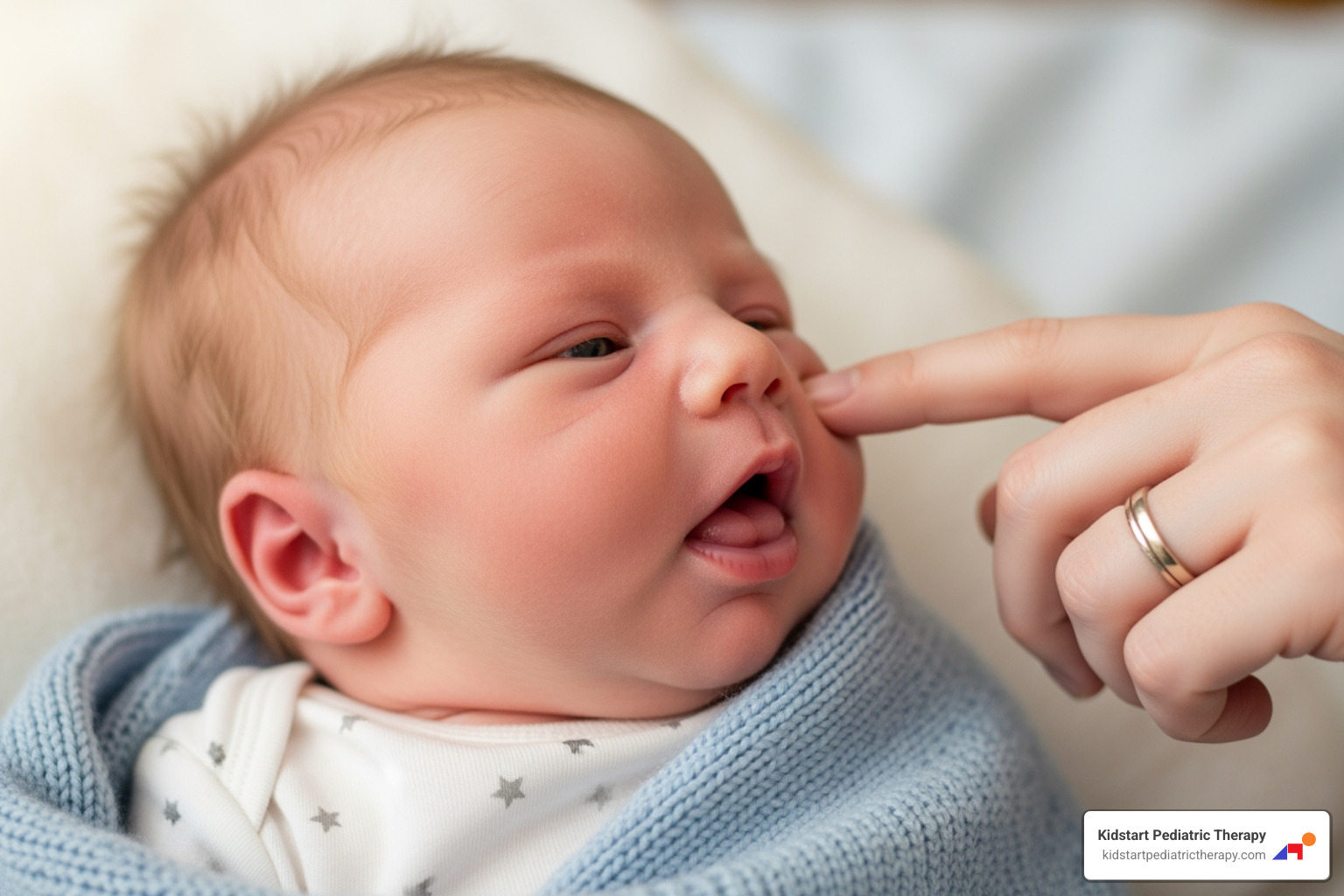
Rooting Reflex: Stroking your baby’s cheek causes them to turn their head toward the touch and open their mouth. This is primarily for feeding but also demonstrates early head movement and coordination.
-
Stepping Reflex: If held upright with their feet on a flat surface, a newborn will appear to take “steps.” This reflex typically disappears after a couple of months.
-
Startle (Moro) Reflex: A loud sound or sudden movement causes a baby to throw back their head, extend their limbs, cry, and then pull their limbs back in. This reflex is usually gone by three months.
As a baby’s brain matures, these reflexes integrate, making way for purposeful, voluntary movements. This transition is a cornerstone of motor development. For a deeper dive, explore resources like Movement Milestones: Birth to 3 Months.
A Month-by-Month Guide to 0-3 Months Fine Motor Skills
The journey through the first three months is a whirlwind of findy for your baby, especially concerning their hands and eyes. We will break down the typical 0 3 months fine motor skills development month by month. Every baby is unique, and these are general guidelines.
| Milestone | Month 1 | Month 2 | Month 3 |
|---|---|---|---|
| Fine Motor Skills | – Hands mostly fisted | – Hands begin to open more | – Hands more relaxed and open |
| – Strong grasp reflex | – Briefly holds rattle (if placed in hand) | – Visually directed reaching (swipes/reaches for objects) | |
| – Jerky arm movements | – Brings hands to mouth | – Grasps and shakes hand toys | |
| – Brings hands near face | – Swipes at dangling objects (often with fisted hands) | – Brings both hands together (midline play) | |
| – Inspects own hands | |||
| Gross Motor Skills | – Lifts head briefly when on tummy | – Lifts head higher during tummy time (up to 45 degrees) | – Lifts head and chest, supported by elbows, during tummy time |
| – Head lag when pulled to sit | – Holds head up more steadily when supported | – Holds head steady when supported in a sitting position | |
| – Kicks legs | – Kicks legs more vigorously | – Stretches legs out and kicks when on stomach or back | |
| Visual/Cognitive | – Eyes track objects to midline | – Follows objects past midline | – Eyes follow objects in a circular motion |
| – Focuses on faces (about 1 foot away) | – Notices own hands | – Makes eye contact | |
| – Smiles back at people | – Begins to tell colors apart | ||
| – Explores environment by looking around | |||
| Hand-Eye Coordination | – Emerging interest in hands | – Brings hands to mouth, notices hands | – Attempts to reach for objects they see, brings hands together at midline for play, inspects hands |
| Grasp Development | – Reflexive palmar grasp (tight fist) | – Grasp reflex diminishes, hands start to open | – More deliberate grasp, can hold small objects (e.g., rattles) in hands, can shake hand toys |
Month 1: Reflexes and Early Awareness
In the first month, movements are largely reflexive. Hands are mostly fisted with a strong, involuntary grasp reflex. Arm movements appear jerky and uncontrolled. Visually, newborns are drawn to faces and begin to track objects toward the midline of their body. They may bring hands near their face and can briefly lift their head during tummy time.
Month 2: Finding Hands and Gaining Control
By the second month, movements become more deliberate. Your baby’s hands open more frequently, and they may briefly hold a rattle placed in their hand. A key milestone is bringing hands to the mouth, which helps them explore their body. Arm movements become smoother, and they may swat at objects. Visually, they can follow objects past the midline. During tummy time, they lift their head higher, building crucial strength.
Month 3: Reaching and Grasping
The third month marks a significant leap in 0 3 months fine motor skills. Hands are more relaxed and open, allowing for purposeful interaction. Visually directed reaching emerges as your baby looks at and swipes at objects. Their grasp becomes more deliberate, and they can hold and shake toys. Bringing both hands together at the midline is another important milestone. During tummy time, they can lift their head and chest while supported on their elbows, further improving postural control. For more details, refer to resources like Developmental Milestones: 3 Months.
How to Support Your Baby’s Motor Skill Development
As a parent, you play a crucial role in nurturing your baby’s development. Providing a supportive and stimulating environment can significantly encourage their 0 3 months fine motor skills. We believe in a holistic, play-based approach where learning is fun. For more on our approach, check out our insights on play-based therapy.
The ‘Comfort, Play, and Teach’ framework can guide your interactions:
- Comfort: Let your baby self-soothe and become familiar with their surroundings. Carrying your baby around your home in Burnaby or Vancouver and talking to them helps develop visual tracking.
- Play: Encourage exploration by providing various textures to touch, letting them grip your finger, and allowing them to explore their own hands.
- Teach: Gently clap their hands together or massage their palms to build body awareness.
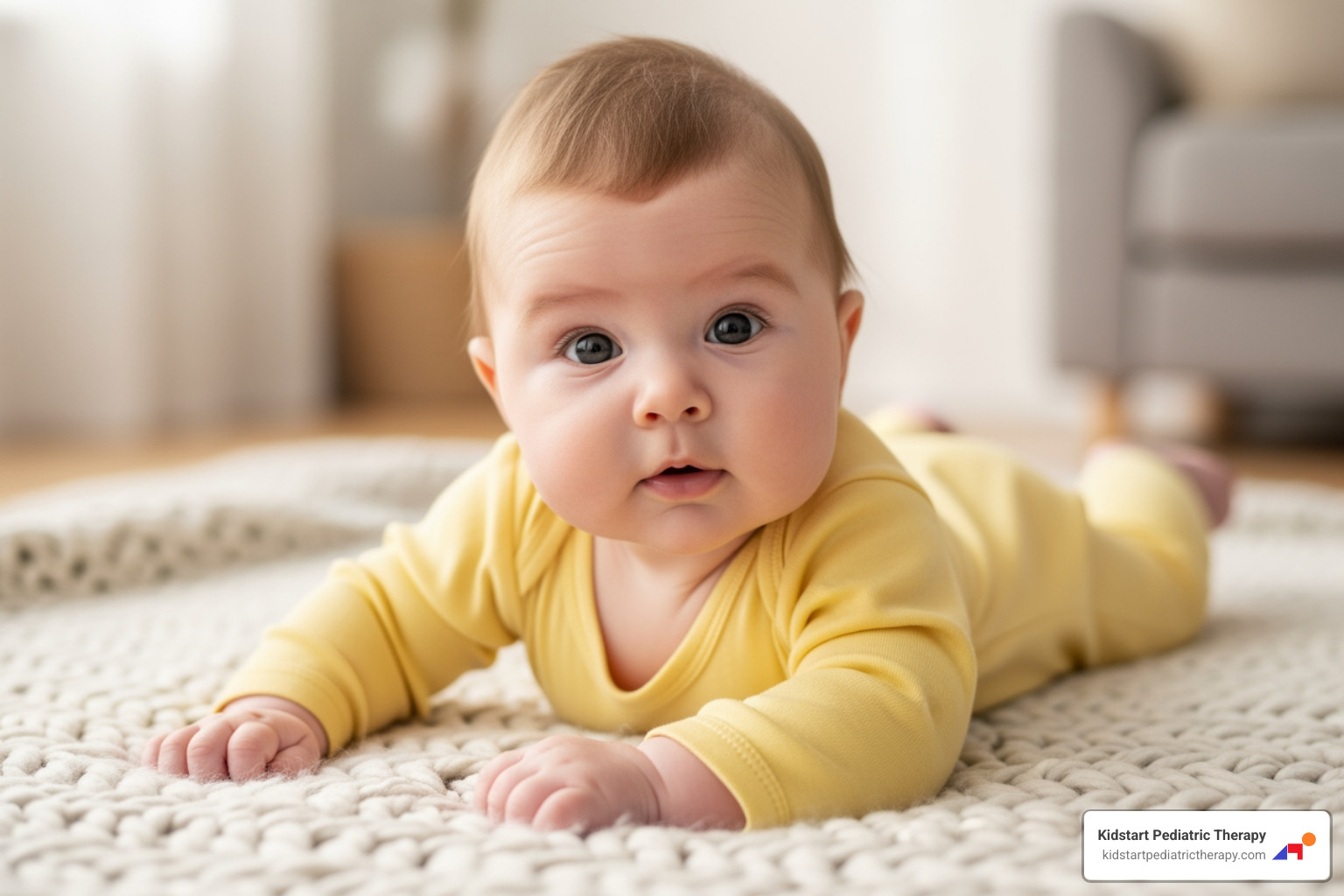
Foundational gross motor skills are developed through activities like tummy time. These activities build shoulder stability and develop the arches in their hands, both crucial for later fine motor control. Limiting time in restrictive equipment like bouncers or infant seats allows for more natural development on the floor.
Simple Activities to Promote 0-3 Months Fine Motor Skills
Here are some simple activities to promote your baby’s developing 0 3 months fine motor skills:
- Tummy Time Variations: Make tummy time engaging with high-contrast toys or a mirror to encourage head lifting and reaching.
- Offering Soft Rattles: Around 2-3 months, gently place a lightweight rattle in your baby’s hand to help their grasp become more voluntary.
- Dangling High-Contrast Toys: Hang soft, high-contrast toys above your baby’s chest to encourage visual tracking and swiping, an early form of hand-eye coordination.
- Gentle Hand Massage: Massaging your baby’s palms and fingers increases their awareness of their hands.
- Clapping Baby’s Hands Together: Gently bring your baby’s hands together to clap, introducing them to midline play and body awareness.
- Skin-to-Skin Contact: This provides rich tactile stimulation and reinforces the grasp reflex as your baby holds your finger.
- Encouraging Reaching: Hold an interesting object slightly out of reach to foster visually directed reaching.
These activities are about gentle encouragement and exploration. Your presence and engagement are the most powerful tools for their development.
The Importance of Tummy Time
Tummy time is a cornerstone of early motor development, with a profound impact on 0 3 months fine motor skills.
Why is tummy time so crucial?
- Builds Upper Body Strength: Pushing up on their arms strengthens the neck, shoulder, and back muscles needed for head control.
- Develops Shoulder Stability: Bearing weight on their arms builds the shoulder stability (“proximal stability”) required for controlled hand and finger movements (“distal mobility”).
- Promotes Hand Arch Development: Pushing up on their hands helps develop the arches in the hands, which are critical for grasping and manipulating objects.
- Prevents Flat Head Syndrome (Plagiocephaly): Tummy time reduces pressure on the back of your baby’s head.
- Improves Visual Development: Lifting their head to look around strengthens eye muscles and encourages visual tracking.
Making Tummy Time Fun:
- Start early with short, supervised sessions, gradually increasing the time.
- Get down on their level to make eye contact and talk or sing.
- Use props like a rolled-up towel for support or an engaging play mat.
- Vary the location, trying it on the floor, across your lap, or on your chest.
By consistently engaging in tummy time, you provide the essential physical foundation for fine motor exploration.
When to Be Concerned: Developmental Red Flags (0-3 Months)
While every child develops at their own pace, it’s important to be aware of certain developmental red flags. Trust your parental instinct; if something feels off, it’s always best to discuss it with a healthcare professional. Early intervention can make a significant difference. We at KidStart Pediatric Therapy are committed to supporting families in Greater Vancouver, including Burnaby, Coquitlam, and Richmond, in tracking their child’s motor milestones. For more information, please see our resource on tracking pediatric motor milestones.
The American Academy of Pediatrics and the CDC’s “Learn the Signs. Act Early.” program emphasize the importance of early identification.
Warning Signs to Discuss with Your Pediatrician
Discuss any of the following signs with your pediatrician in Burnaby, Coquitlam, or Vancouver, as they might indicate a need for further evaluation:
- Seems very stiff or very floppy: Muscles feel unusually rigid or loose.
- Doesn’t grasp objects by 3 months: Shows no attempt to grasp a finger or toy.
- Doesn’t bring hands to mouth by 3 months: This is a key step for self-exploration.
- Doesn’t follow moving objects with eyes by 2-3 months: Persistent difficulty tracking can be a red flag.
- Poor head control at 3 months: Still has significant head lag or cannot lift head during tummy time.
- Asymmetrical movements: Consistently uses one side of the body more than the other.
- Doesn’t respond to loud noises by 2 months: Lacks a startle response or doesn’t turn towards sound.
- Doesn’t smile at people by 3 months: The social smile is an important developmental marker.
- Losing skills they once had: This is a significant warning sign at any age and warrants immediate attention.
- Persistent crossed eyes: Occasional crossing is normal, but if it persists past 2-3 months, it should be evaluated.
If you observe any of these signs, reach out to your pediatrician. Resources like the CDC’s Learn the Signs. Act Early. campaign also provide valuable tools for parents.
Conclusion: Celebrating Every Tiny Milestone
The first three months are an incredible period of growth, laying the groundwork for all future learning. From a reflexive grasp to a deliberate reach, every movement is a significant step in your baby’s journey. We’ve seen how 0 3 months fine motor skills are intricately linked with gross motor, visual, and social development.
We encourage you to celebrate each milestone and engage with your baby through play and responsive care. While every baby develops at their own pace, understanding these general milestones empowers you to be an informed and confident parent.
At KidStart Pediatric Therapy, we are dedicated to supporting families across Burnaby, Coquitlam, Vancouver, New Westminster, Langley, Richmond, and the broader Greater Vancouver area. Our team of highly qualified and certified therapists offers compassionate, personalized pediatric occupational, speech, and behavior therapy, focusing on early intervention to help your child reach their full potential. If you ever have concerns about your child’s motor development, we are here to help.
To dig deeper into the fascinating world of movement and development, we invite you to learn more about motor skills development on our website.